
Garn Wen Dolmen
The Garn Wen Burial Chamber, situated on a prominent hillside overlooking Goodwick and the sweeping waters of Fishguard Bay, is one of Pembrokeshire’s most important and evocative prehistoric monuments.
Commanding wide views across land and sea, the site occupies a deliberately chosen position within the landscape, reflecting the deep connection between Neolithic communities and their environment.
Garn Wen Dolmen
Dating from the Neolithic period, approximately 3,500 – 2,500 BCE, Garn Wen forms part of a wider concentration of chambered tombs in North Pembrokeshire, an area that was clearly a focal point for early farming societies.
These burial monuments – commonly referred to as cromlechs or dolmens – were constructed by some of the earliest settled communities in Wales. Far more than simple graves, they functioned as communal burial places and ceremonial spaces, closely linked to ritual, memory, and ancestral identity. Their enduring stone architecture suggests that the people who built them intended these structures to last, serving as permanent markers of territory, lineage, and belief. Through sites like Garn Wen, archaeologists gain valuable insight into how Neolithic people understood life, death, and the cyclical nature of existence.
Originally, the Garn Wen site comprised three separate burial chambers arranged within a larger funerary complex. Each chamber was formed from substantial upright stones, known as orthostats, which supported heavy horizontal capstones weighing several tonnes. Although centuries of weathering, collapse, and stone robbing have altered the site’s original appearance, the remaining structures still clearly display the characteristic form of Neolithic chambered tombs. These chambers would once have been enclosed beneath a long mound of earth and stone – known as a long barrow – creating an imposing monument that would have been highly visible from across the surrounding hills and coastal plain.
The scale of construction at Garn Wen highlights the organisational abilities of Neolithic communities. Transporting, shaping, and erecting such massive stones would have required coordinated labour, planning, and shared purpose, indicating a stable, cooperative society rooted in agriculture. Excavations and comparative studies of similar sites suggest that these chambers housed the remains of multiple individuals, placed there over many generations. Rather than honouring single elites, Garn Wen likely served as a collective ancestral monument, reinforcing social bonds and continuity within the community.
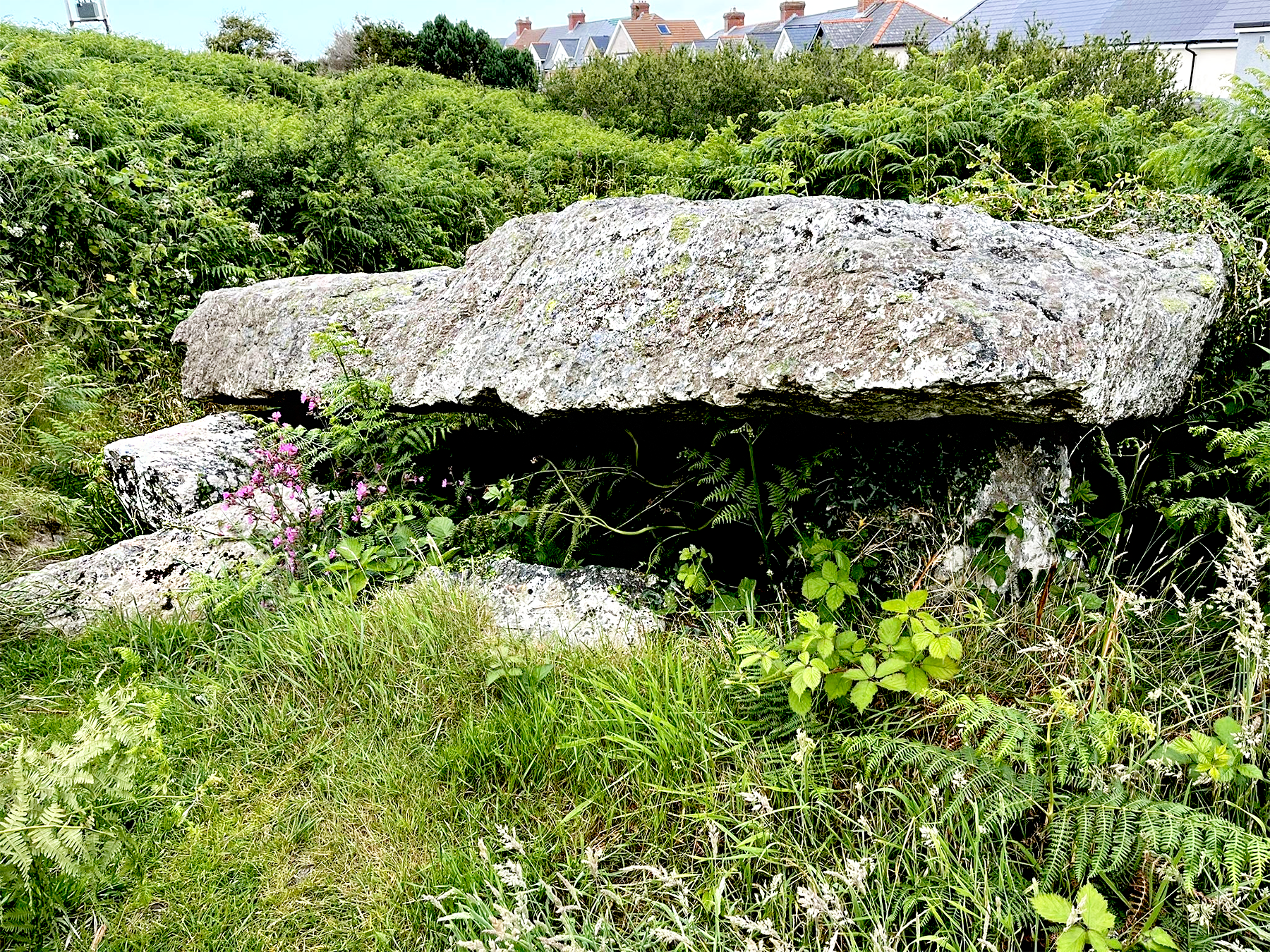
Archaeological research has also shown that burial chambers like Garn Wen were not static spaces. Human remains were often rearranged, removed, or added over time, suggesting ongoing ritual interaction with the dead. These practices point to a belief system in which ancestors remained an active presence, shaping identity and offering protection or legitimacy to the living. The alignment and placement of such tombs within the landscape may also have held symbolic meaning, possibly relating to seasonal cycles, territorial boundaries, or spiritual cosmology.
Today, the Garn Wen Burial Chamber remains a striking and atmospheric landmark, valued not only for its archaeological significance but also for its setting.
Easily reached from Goodwick, it is a popular destination for walkers, history enthusiasts, and those seeking a deeper connection to Pembrokeshire’s ancient past. From the site, panoramic views stretch across Fishguard Bay, reinforcing the sense that this was a place where land, sea, and sky converged in ways that were meaningful to its builders.
As a protected archaeological monument, Garn Wen continues to be carefully preserved, allowing visitors to engage with a landscape shaped by human activity for over five thousand years. Standing among its weathered stones offers a powerful reminder of the endurance of human memory and the long, layered story of settlement in North Pembrokeshire – a story that remains written into the hillsides overlooking Goodwick today.