
Fishguard Town History
Although many of Fishguard’s buildings appear, at first glance, to date no earlier than the eighteenth century, a closer examination reveals that much of the town is built upon far older foundations.
Beneath the later façades lie the physical remains of medieval structures, reflecting centuries of continuous occupation and rebuilding.
Fishguard Town History
Fishguard’s development as a town was slow and uneven, shaped by geography, limited resources, and centuries of modest growth, although early records suggest it may have been used as a Norse Settlement due to the areas original name being Fiscard, meaning Fish Trap. Medieval records relating to Fishguard are extremely scarce, making its early history difficult to reconstruct in detail.

What is generally believed, however, is that the settlement began to take shape in the 12th century, traditionally attributed to Martin of Tours and Martin De Turrubus, Norman lords associated with the early development of the area. At this time, Fishguard was little more than a small coastal community, centred on fishing, small-scale trade, and agriculture, with no real urban structure in the modern sense.
For many centuries, Fishguard remained a relatively minor settlement. Nearby Goodwick, which today forms part of the same urban area, was not a town at all but simply a small beach cove and natural landing place. It served as a sheltered anchorage for boats and fishing vessels rather than a permanent settlement, and it would not begin to develop into a community until many centuries later, particularly with the arrival of industry and the railway in the nineteenth century.
The gradual growth of Fishguard took place inland from the harbour, in what is now known as Lower Fishguard.
This lower area, close to the water, formed the original nucleus of the town. From here, the settlement slowly expanded uphill, but development was limited and tightly constrained. For a long period, Fishguard consisted of only a few main thoroughfares: Fishguard Square, High Street, and Main Street. These streets formed the entirety of the town’s built environment, giving Fishguard a compact and crowded character.
By the late medieval and early modern periods, Fishguard was classified as a fishing village settlement rather than a town. Despite its strategic coastal position, it remained economically poor and chronically overpopulated. Living conditions were harsh, with small, tightly packed dwellings, limited sanitation, and little formal infrastructure. Contemporary descriptions and later records suggest that the streets were often in poor condition, and horse-drawn transport contributed to unsanitary conditions. Dung heaps were a common sight throughout the settlement, accumulating in streets and open spaces, reflecting both the lack of organised waste removal and the realities of daily life in a working coastal village.

Social and commercial life was extremely limited. At one point, Fishguard is recorded as having only a single public house or inn to serve the entire community, highlighting both the town’s small size and its restricted economic activity. Most residents relied on fishing, smallholdings, and seasonal labour, with poverty a persistent feature of everyday life well into the eighteenth and early nineteenth centuries.
Throughout the medieval period, Fishguard remained a relatively small and secondary settlement, overshadowed by Newport, which was the principal town of north Pembrokeshire and the region’s main centre of trade, administration, and population. Fishguard’s role was largely limited to fishing and local coastal activity, and it did not experience significant growth while Newport prospered.
This situation began to change in the sixteenth century following outbreaks of the great plague in Newport, which severely reduced its population and disrupted its economy. As families, traders, and business owners in Newport either perished or abandoned the town, Fishguard increasingly became an alternative place of settlement and activity.
This shift allowed Fishguard’s population to grow for the first time in a sustained way, marking an important turning point in its development and gradually setting it on the path from a minor fishing village towards becoming the dominant settlement in the area.
During this period, Fishguard was also believed to have possessed a royal charter granted by King John in the early thirteenth century, which would have conferred important legal and commercial privileges on the settlement. Such a charter would have reinforced Fishguard’s status as a recognised borough or market centre, granting rights related to trade, governance, and self-administration. However, this charter was reportedly lost during the upheaval of the seventeenth – century Civil War, a time when many official records were destroyed, displaced, or neglected. No surviving official documentation of the charter has ever been found, and its existence is known only through reference in an old newspaper cutting from many decades ago. As a result, the charter remains an intriguing but unproven part of Fishguard’s history, highlighting both the town’s historical aspirations and the fragmentary nature of its early records.
Later in the eighteenth century, Fishguard became the site of one of the most remarkable events in British history when it was attacked by French forces in 1797. This episode, often referred to as the last invasion of mainland Britain, saw French troops land near the town as part of an ambitious but ultimately unsuccessful attempt to destabilise Britain during the Revolutionary Wars. Although brief, the invasion left a lasting mark on Fishguard’s identity, further highlighting its strategic coastal importance and securing its place in national as well as local history.
At the heart of this tightly packed settlement stood what would later become Fishguard Market Square. Until the 1830s, a cottage occupied the centre of this space, physically and symbolically restricting its use as a public area. The removal of this building marked an important turning point in the town’s development.

Clearing the space created an open square that could be used for markets, gatherings, and civic functions, laying the groundwork for a shared communal centre. Once opened up, the Square quickly became the focal point of Fishguard’s social, economic, and political life. It was surrounded by key institutions, including market facilities, local inns, municipal buildings, and most importantly, St Mary’s Church. The church is believed to have medieval origins, possibly dating back to the early period of the town’s formation, before being extensively rebuilt in the nineteenth century. Its presence provided a spiritual and physical anchor around which the town continued to evolve, and the open space beside it naturally became known as “the Square.” During a period of growing prosperity in the late eighteenth century, Fishguard obtained the formal privileges of a market town, marking a significant milestone in its economic and civic development.
This new status allowed the town to hold regular markets and fairs, strengthening its role as a centre of trade for the surrounding rural communities. In this period, fairs were important social and commercial events, drawing farmers, traders, and visitors from across north Pembrokeshire. Fishguard hosted several annual fairs, held on 5 February, Easter Monday, Whit Monday, 23 July, and 17 November, each serving different agricultural and trading purposes. These occasions helped to stimulate the local economy, encourage population growth, and further establish Fishguard as an emerging hub of commerce and community life in the region.
Although many of Fishguard’s buildings appear, at first glance, to date no earlier than the eighteenth century, a closer examination reveals that much of the town is built upon far older foundations. Beneath later façades lie the physical remains of medieval structures, reflecting centuries of continuous occupation and rebuilding.
St Mary’s Church, for example, was extensively rebuilt in the nineteenth century, yet its foundations and some of its masonry originate from an earlier church recorded in 1291.
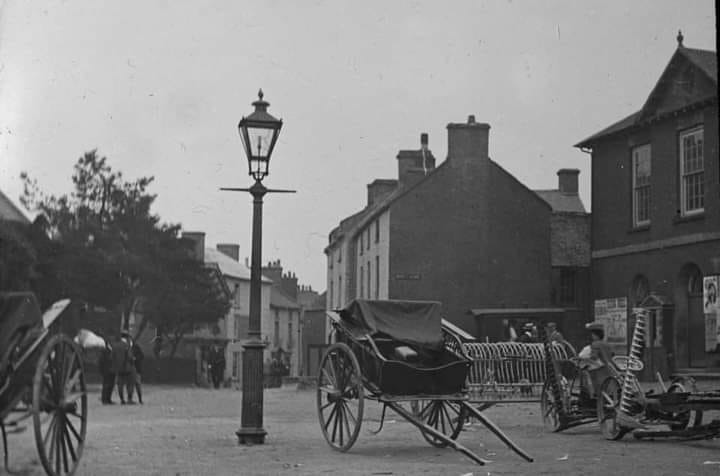
Over time, Fishguard Square underwent numerous transformations, reflecting changing needs and fashions. In different periods, it featured a central fountain, a prominent Victorian street lamp, and even a large roundabout designed to manage increasing traffic. Each alteration marked a new phase in the town’s development, from a crowded fishing village to a more organised civic centre. Today, Fishguard functions as a busy and welcoming town centre, with widened pavements, improved public spaces, and facilities designed to serve both residents and visitors.
Beneath its modern appearance, however, lie centuries of layered history. The Square and many other streets stand as a testament to Fishguard’s gradual growth from a small, impoverished medieval fishing settlement – once defined by narrow streets, overcrowding, and hardship – into the town that continues to serve as a focal point for the surrounding community.
Although many of Fishguard’s buildings appear, at first glance, to date no earlier than the eighteenth century, a closer examination reveals that much of the town is built upon far older foundations.
Beneath later façades lie the physical remains of medieval structures, reflecting centuries of continuous occupation and rebuilding. Similarly, houses around the Square, High Street, Parc y Shwt, and Main Street incorporate fragments of older stonework and reused materials, indicating that newer buildings often replaced earlier ones on the same plots.
Archaeological excavations at the Farmers Arms in the 1990s uncovered medieval deposits, supporting evidence that the building originally began life as a private house before later becoming an inn.
Together, these hidden layers remind us that while Fishguard’s streetscape may appear relatively modern, much of its deeper history remains embedded within its walls and beneath its streets.
