
The Battle of Goodwick 1078
A glimpse at the early history of the area, and the medieval significance of the battle which stands as a reminder of Goodwick’s strategic importance within Wales.
Rhys ap Owain vs
Trehaearn ap Caradog
Battle of Goodwick 1078
The medieval Battle of Goodwick was fought in the late 11th century, in 1078, on the open ground now known as Goodwick Moor, and represents a significant episode in the turbulent power struggles of early medieval Wales.
At this time, Wales was divided among rival kingdoms whose rulers were frequently engaged in warfare, alliances, and dynastic rivalry. The battle formed part of a wider conflict between the northern kingdom of Gwynedd and the southern kingdom of Deheubarth, both of which sought to extend their influence across west Wales and control key territories such as in what is now north Pembrokeshire.
The opposing forces were led by two prominent figures of the period: Trehaearn ap Caradog of Gwynedd and King Rhys ap Owain of Deheubarth. The clash was rooted in long-standing territorial disputes and political instability, exacerbated by cycles of revenge killings and shifting allegiances among Welsh rulers. One of the key triggers for renewed hostilities was the killing of Bleddyn ap Cynfyn, a powerful ruler whose death unsettled the delicate balance of power across Wales.
In the aftermath, Gwynedd moved decisively to assert dominance beyond its traditional borders, while Deheubarth sought to defend its lands and preserve its authority against northern encroachment.
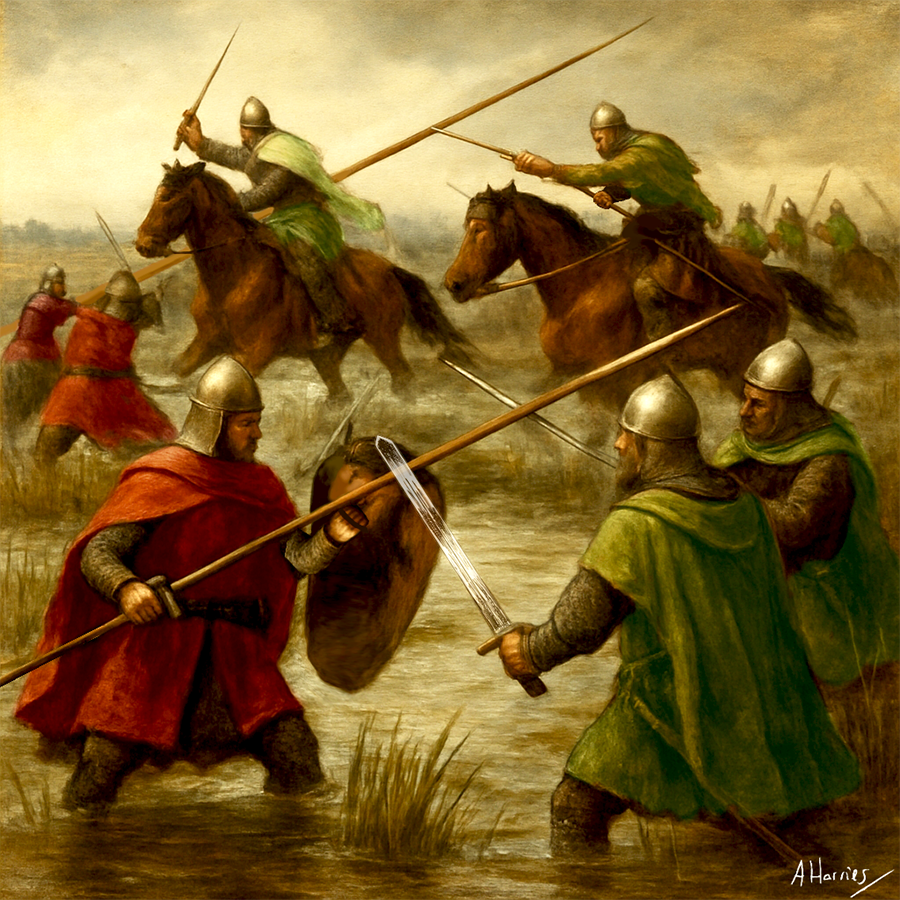
Contemporary and later historical sources suggest that the battlefield on Goodwick Moor was strategically chosen. The open, elevated terrain provided clear lines of sight and room for manoeuvre, favouring an army that was well organised and familiar with the local landscape. Trehaearn ap Caradog, an experienced and capable military leader, is thought to have travelled across by boat and positioned his forces carefully, making effective use of the terrain to control movement and maintain cohesion. His troops were likely arranged in disciplined formations, enabling them to respond flexibly during the fighting.
In contrast, although Rhys ap Owain commanded a substantial force, his army appears to have struggled with coordination across the uneven and exposed ground. The challenges of moving large numbers of men over moorland terrain, combined with the intensity and confusion of hand-to-hand combat typical of medieval warfare, likely undermined Deheubarth’s effectiveness. These difficulties, coupled with Trehaearn’s tactical advantage, contributed to the eventual collapse of Rhys’s resistance.

The battle ended in a decisive victory for Gwynedd, with far-reaching political consequences. Trehaearn’s success consolidated Gwynedd’s influence in the region and significantly weakened Deheubarth’s control over parts of what is now Pembrokeshire. More broadly, the outcome reshaped the balance of power in medieval Wales, illustrating how regional dominance could shift rapidly through military success. The battle also underscored the crucial importance of leadership, strategy, and intimate knowledge of the local landscape in determining the outcome of conflicts during this period.
In the centuries that followed, Goodwick Moor became firmly associated with the memory of this confrontation. Although no visible traces of the battle survive today – such as earthworks, weapons, or mass graves – the event is preserved through medieval chronicles, later historical writing, and local tradition. These sources help to maintain the site’s identity as a place of conflict and decision, where the future of Welsh kingdoms was shaped by force of arms.

Today, the Battle of Goodwick is recognised as an important chapter in the early history of the area, adding a layer of medieval significance to a landscape already rich in prehistoric heritage. For modern visitors, the moor offers little outward sign of its violent past, yet understanding its history transforms it into a place of deep historical resonance.
The battle stands as a reminder of Goodwick’s strategic importance within Wales and provides valuable insight into the complex military, political, and territorial dynamics of medieval Welsh society. The site now has a medieval trail with a virtual tour, as well as a red heritage plaque.
